
Missing or lost a tooth? Your dental implant options in Greenville
By Kai Ramos · Updated 2026-07-08

Losing a single tooth, whether from an accident, decay, or an extraction your dentist recommended, leaves you with a real decision to make, and there’s no single right answer for everyone. Here’s how the options actually compare, and what tends to matter most in choosing between them. Local providers for single-tooth cases are listed in our single tooth implant category.
Your main options
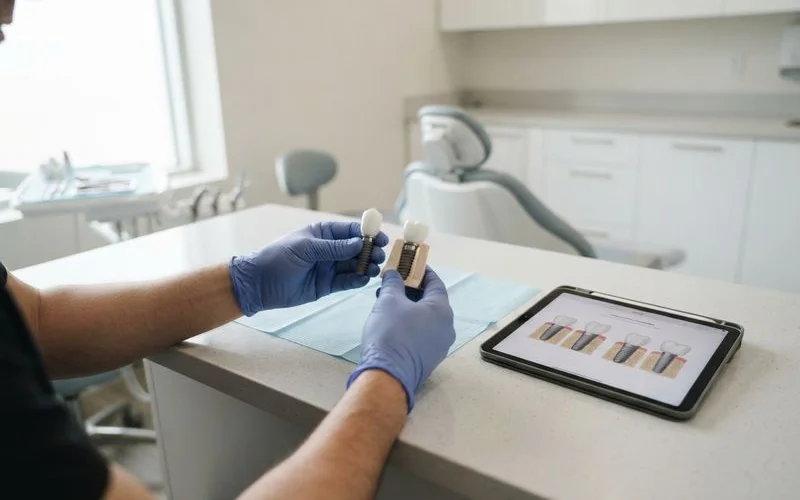
Single-tooth implant. A titanium post placed into the jawbone topped with a crown. It doesn’t rely on neighboring teeth for support, which is its biggest structural advantage, and it typically lasts many years with normal care.
Fixed bridge. Uses the two neighboring teeth as anchors for a replacement tooth in between. It can be faster to complete than an implant, since it doesn’t require a healing period for bone integration, but it means altering otherwise healthy adjacent teeth to support the bridge.
Removable partial denture. The least invasive and typically least expensive option, but also the one most people find least comfortable long-term, since it’s removable and can affect chewing and speech more noticeably than a fixed option.
Doing nothing for now. Sometimes reasonable short-term, but neighboring teeth can gradually shift into the gap, and the jawbone in that area tends to shrink over time without a tooth root to maintain it, both of which can complicate treatment later.
None of these options is automatically wrong for a given situation. A back molar that’s rarely visible and doesn’t affect your bite may not need immediate replacement, while a front tooth affecting your speech or confidence in everyday situations often warrants faster action. The location and function of the missing tooth matters as much as the general pros and cons of each option.
| Option | Involves neighboring teeth? | Typical timeline |
|---|---|---|
| Single-tooth implant | No | Months, due to healing time |
| Fixed bridge | Yes, used as anchors | Weeks |
| Removable partial denture | No, but rests near them | Weeks |
| Waiting | N/A | Ongoing, with some risk of complications later |
If it just happened (an accident or sudden loss)
See a dentist as soon as reasonably possible. If the tooth is intact, sometimes it can be reimplanted if you act quickly; if not, the socket needs evaluation for infection and bone condition. Immediate placement of an implant at the same visit is sometimes possible, but it depends entirely on what the socket and surrounding bone look like, which only an exam and imaging can confirm.
If it’s a planned extraction
You have more time to plan, which is an advantage. Ask your dentist whether socket preservation (packing the extraction site with graft material to limit bone loss) makes sense for your case, since it can keep implant placement simpler down the line if you decide to wait a few months before moving forward. This is worth raising even if you haven’t decided on an implant yet, since it keeps that option genuinely open rather than closing it off by default. If bone volume turns out to be limited by the time you’re ready to move forward, our guide on bone grafts and sinus lifts before implants covers what that step typically involves.
What actually drives the decision
Cost, the condition of neighboring teeth, how quickly you want the gap addressed, and your own long-term preferences all factor in. There’s no universally “best” choice, only the option that fits your specific mouth, budget, and timeline. A thorough consultation, including imaging, is what turns this from a guess into an informed decision.
It’s reasonable to get a second opinion if the first recommendation you hear doesn’t sit right with you, particularly for a decision you’ll live with for years. A second consultation costs some time, but it can clarify whether a specific recommendation reflects your situation or simply how one office tends to approach these cases. Bring your own notes and any questions from the first visit along, since comparing specific answers side by side is more useful than comparing a general impression of each office.
This is general information, not a specific treatment recommendation. Your own best option depends on an in-person exam.
You can browse local providers from the home page, and our methodology page explains how we evaluate offices on more than star ratings alone.
Frequently asked questions
- How soon after losing a tooth can I get an implant?
- It depends on the socket and surrounding bone. Some patients get an implant placed at the same visit as an extraction; others need a few months of healing first if there's infection or significant bone loss.
- Do I have to replace a missing tooth right away?
- Not urgently in most cases, but waiting too long can let neighboring teeth shift and bone in the area shrink, which can make replacement more involved later.
- Is an implant always better than a bridge?
- Not always. A bridge can be a reasonable option depending on the condition of neighboring teeth, cost, and your own preferences. An implant avoids altering adjacent teeth, which is its main structural advantage.
- What if I don't have enough bone for an implant right away?
- A bone graft can often build up the site over several months before an implant is placed. Your surgeon will confirm this with imaging rather than a visual exam.